
DRB 330: Experimental Approaches to Developmental and Regenerative Biology
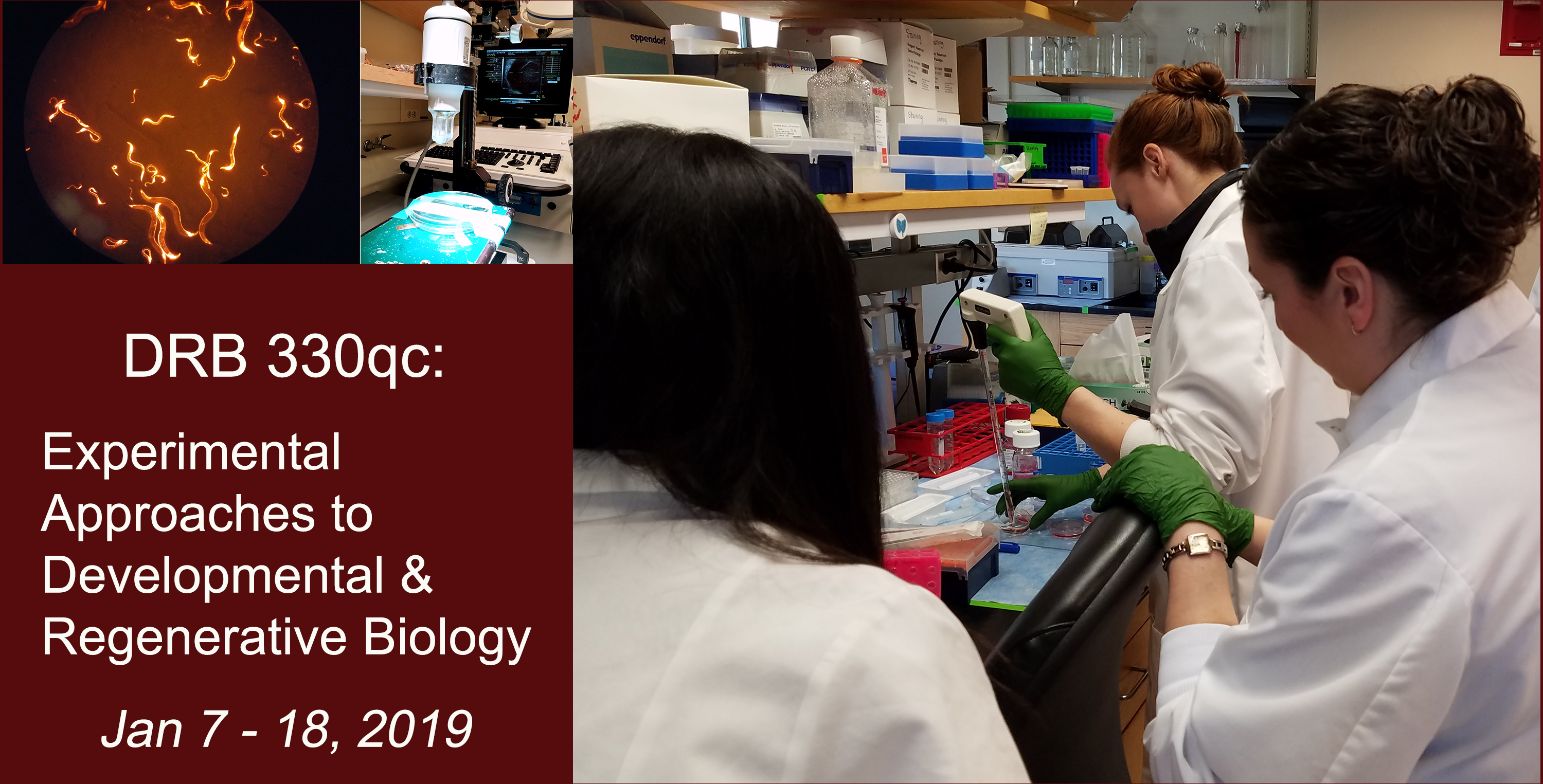
Enrollment for DRB 330qc: Experimental Approaches to Developmental and Regenerative Biology is open through my.harvard. Course runs Jan 7th – Jan 18, 2019 and covers a wide spectrum of stem cell and whole organism model systems studied in DRB/SCRB-affiliated labs across the Harvard community. It’s going to be fun, exciting and you’ll learn a lot. So, join us today!
Each of the 9 classes consists of an introductory lecture to the model and/or organ system of the day, followed by hands-on interactive laboratory sessions designed to let you test out the various experimental techniques used in DRB program labs.
The course is always fun, and you’ll learn a lot of new techniques in a low-stress environment. More importantly, it is a great way to get to know the other DRB/SCRB faculty and trainees.
Please note, while this course is a DRB program requirement, DRB330qc is open to anyone with an interest in trying the variety of experimental model systems and research areas covered in DRB/SCRB- affiliated laboratories at Harvard.
The advantages of DRB 330qc participation:
~28% of BBS faculty are self-declared “developmental biologists”, and approximately 52% of BBS students rotate in at least one of these labs during their graduate training.
1) Our DRB community brings researchers and scholars together from across the Harvard campuses and affiliated hospitals in a synergistic and supportive way that can help you handle experimental, intellectual and personal challenges during your time in the lab.
2) The transition to graduate school presents a unique and special time in your scientific training where you have the flexibility to learn about and explore a broad range of contemporary research topics and methods without long-term commitment.
3) DRB 330qc was developed with these aims in mind, allowing both tool-box and cohort building through informative interactive class sessions, including student led mini-project pitch presentations and an end-of-course party with the larger DRB community.
4) Our newly reformatted 2-week course block covers a larger expanse of topics, and pairs DRB/SCRB faculty to highlight the ability and benefits of working collaboratively across model systems to answer complex questions in developmental biology and/or advance the understanding and treatment of developmental or acquired human disorders and diseases.
5) DRB 330qc is a great way to interact informally with DRB/SCRB faculty who may later serve on your PQE, DAC and thesis committees, as well as meet peers and potential collaborators from other graduate class groups throughout the Harvard community.
See below for additional information and resources.
True Stories from DRB 330
We asked our students to reflect on 330. Here are a few of their comments.
- I changed my third rotation and ultimately ended up joining the lab of a DRB 330 faculty member I wouldn’t have otherwise considered.
- DRB 330 solidified my rotation choices
- I made friends with the students in the course and they have remained some of my closest friends throughout grad school.
- The reviews, techniques and background covered in DRB 330 helped greatly with my PQE prep and beyond.
- Provided me with one of the best perspectives on becoming a PI that I’ve ever heard.
What's new for this year?
- Team-taught sessions to diversify background and include faculty in allied research areas from across Harvard-affiliated institutions.
- Opportunity to get feedback on potential rotation projects with faculty
2019 Course Schedule
Monday, January 7th, 2019 – January 18th, 2019, 10 – 4 pm
Location: Varies
Date & Time | Faculty & Affiliation | Topic |
1/7 | Jennifer Waters, Nikon Imaging Center | Molecular Microscopy |
1/8 | Olivier Pourquie, HMS Genetics and BWH | Gastrulation and patterning in chick, mouse and iPSC models |
1/9 | Matt Pecot and Davie Van Vactor, HMS | Drosophilia neuromotor connectivity |
1/10 | Eric Greer, Children’s Hospital | Epigenetic regulation in C. Elegans and Dictostelium Discoideum |
1/11 | Jeff Macklis, Harvard Stem Cell and Regenerative Biology & The Allen Institute | Neuromotor cortex in mouse and iPSC models |
1/12 | Trista North and Wolfram Goessling, Children’s Hospital, DFCI & Brigham and Women’s Hospital | Organogenesis in zebrafish |
1/14 | Da Zhi Wang, Children’s Hospital | RNA biology and cardiovascular regeneration |
1/15 | Jessica Whited and Jessica Lehoczky, Harvard Stem Cell and Regenerative Biology & Brigham and Women’s Hospital | Regeneration in the axolotl |
1/16 | Ya-Chieh Hsu, Harvard Stem Cell and Regenerative Biology | Development and regeneration in mammalian skin |
1/17 | April Craft and Jenna Galloway, Children’s Hospital & MGH | Regeneration and repair of cartilage, bone and joints |
1/17 | Annual New Year’s Party |
|
1/18 | Students | Presentation Showcase |
FAQ
1. Is this required for DRB Membership?
Yes, to be a full, development-award eligible member of DRB you are required to take DRB 330 and CB 207 in the spring.
2. There’s class on Saturday?
Yes, Profs. North and Goessling shut down their labs to make them available for Bootcamp.
3. How can I still get started on rotations if I’m taking this class?
It’s possible and our students have done it. Talk to us: theodore_feldman@hms.harvard.edu, Trista.north@childrens.harvard.edu. We’ll help and we can connect you with students for some more tips.
4. I’ll have to miss ___ day of DRB 330, can I still participate?
Talk to us: theodore_feldman@hms.harvard.edu, Trista.north@childrens.harvard.edu .
5. What is the DRB Annual New Year’s Party?
A senior member of DRB, either student or faculty hosts DRB 330 students, DRB members, students and faculty alike to join us for a fun-filled social get together to kick off the new year and celebrate with you, our newest cohort of DRB students.
6. What do we have to do?
Grading is sat/unsat. We expect you to attend session and actively participate. The course will culminate in a presentation session in which we will ask you to give a short (5 min) presentation of your idea for a rotation project based upon the lab of your choice.
Questions?
Contact: Ted Feldman, CF for DRB at: theodore_feldman@hms DOT harvard DOT edu or Trista North, Course Director at Trista.north@childrens DOT harvard DOT edu.